Water Pump Troubleshooting: 10 Common Problems and Fixes
Won’t start, no water, low pressure, overheating: a symptom-by-symptom checklist before you call a technician.
Read guide
A float switch is a floating level sensor that starts or stops a pump, valve or alarm as the liquid rises and falls. Alden float switches come with 3 m, 5 m or 10 m cable for sumps, tanks, sewage pits and ponds across the UAE.
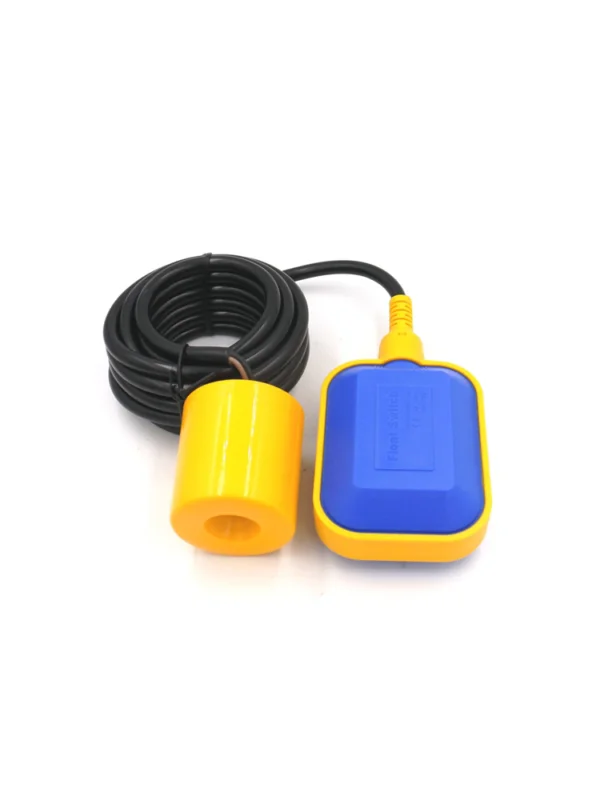
A float switch is a liquid level sensor made of a hollow floating body with a switch inside. It rises and falls with the water and opens or closes an electrical circuit, so it can start or stop a pump, operate a valve or trigger an alarm. Alden float switches come with 3 m, 5 m or 10 m cable.
A basement sump in a Dubai villa fills slowly after every shower on the roof terrace. Nobody checks it, and one night the water reaches the floor. A float switch changes that story. The float rises with the water, the switch closes, the pump starts, and the sump empties by itself without anyone noticing.
A float switch moves up and down with the liquid level. Inside the hollow floating body is a switch, most commonly a reed switch with a magnet. A counterweight and a pre-set trigger point decide when the switch opens or closes as the level changes. When the switch is closed, current passes to the connected device, such as a pump.
The float is usually hung on its own cable. Where the cable is clamped sets the working range: the float swings and tilts between a low and a high position, switching at each end.
| Product | Cable length | Technical data | Enquiry |
|---|---|---|---|
| Float switch 3 m cable | 3 m | Datasheet on request | |
| Float switch 5 m cable | 5 m | Datasheet on request | |
| Float switch 10 m cable | 10 m | Datasheet on request |
Electrical rating, cable type and materials are shown on the datasheet. Request a quote and mention the pump or load you want to control.
| Application | What the switch does | Typical setting |
|---|---|---|
| Sump and sewage pits | Starts the pump when the level rises | Basements, car parks, pump pits |
| Water tanks | Starts or stops transfer pumps at set levels | Potable water, rainwater, wastewater and sewage tanks |
| Refrigeration and air conditioning | Controls the water level | Condensate and cooling water sumps |
| Beverage industry | Controls filling or emptying of tanks | Process tanks |
| Industrial washers | Monitors the water level | Wash tanks and machines |
| Garden and pond pumps | Prevents dry running and floods | Terrace pits, planters, ponds |
Typical use cases: emptying a basement sump, controlling a roof tank filled by a transfer pump, stopping a pond pump before it runs dry, raising a high-level alarm in a drainage pit.
| Situation | Without a float switch | With a float switch |
|---|---|---|
| Sump fills up | Someone must notice and switch the pump on | Pump starts at the set level |
| Tank is empty | Pump runs dry and overheats | Pump stops before the inlet is exposed |
| Tank is full | Water overflows | Pump stops at the high level |
Choose a float switch for simple, low-cost on/off control of pumps in tanks and pits. Choose a pressure kit for taps and boosters, and an electronic level sensor for exact or continuous level readings.
| Option | Suited to | Limits |
|---|---|---|
| Float switch | Tanks, sumps, pits, on/off control | Needs room to move freely; contact rating is limited |
| Vertical pressure kit | Starting a pump when a tap opens | Controls pressure, not tank level |
| Electrode or probe relay | Conductive clean water, fixed positions | Needs a relay panel and does not suit all liquids |
| Ultrasonic or pressure level sensor | Exact or continuous level readings | Higher cost and electronics |
Common mistakes: letting the float catch on a pipe, running a large pump straight off the switch, setting the off level below the pump inlet, and leaving the cable tangled round the pump.
Float switches carry mains voltage in wet places. Typical practice is to use a suitably rated protective device, keep joints out of the water and have a qualified electrician make the connections. Ask us for the electrical rating of the model before you connect a pump to it.
A level sensor that moves up and down with the liquid. It has a hollow floating body with a switch inside. As the level rises or falls, the float tilts or lifts and opens or closes the switch, which can start a pump, close a valve or sound an alarm.
The most common design uses a reed switch with a magnet inside the float. A counterweight and a pre-set trigger decide at what level the switch opens or closes. When the switch closes, current passes to the connected device, such as a pump.
Alden float switches are offered with 3 m, 5 m and 10 m cable. Pick the length that reaches from the tank or sump to your control panel or pump with a little spare, so you do not need a joint in the cable.
Only if the pump’s current is within the switch’s contact rating. For larger or three-phase pumps, wire the float switch to a contactor or control panel instead. Ask us for the rating of the model you choose before you connect it.
Pump-down empties a sump or pit: the pump starts when the float rises and stops when it falls. Pump-up fills a tank: the pump starts when the float drops and stops when it rises. The same float can do either, depending on how it is wired and set.
With a tethered float, the length of free cable between the float and the clamp sets the switching range. A longer free cable gives a wider gap between on and off levels. Set it so the pump stops before the water falls below the pump inlet.
Float switches are widely used in sump pits and sewage pits, as Alden’s product information notes. Keep the float free to move, away from walls, pipes and the pump flow, and clean it if grease or solids build up on the body.
Float switches are used on tanks for potable water, rainwater, wastewater and sewage. For drinking water, ask us for the material details of the model and confirm it is acceptable for your tank and local rules.
It is strongly recommended. Without one, a pump must be started and stopped by hand, or it may run dry. A float gives automatic operation. See our drainage pumps and sewage cutter pumps.
Yes. It is a simple on/off signal, so it can operate a solenoid valve, an electric ball valve, a pump contactor or a high-level alarm. Use a relay if the load is above the switch’s contact rating.
The usual faults are a float stuck on a pipe or wall, a cable tangled around the pump, a build-up of grease or scale on the body, and water entering through a damaged cable. Check the float moves freely and inspect the cable regularly.
Yes. We supply float switches with our pond pumps and other Alden pumps, or on their own. Tell us the pump and we will quote the right switch.
Share the application, the flow and head you need (or the pump you are replacing) and our team will come back with a recommendation and price. Prefer to talk? Call or WhatsApp us.